Stop rewriting.
Start approving.
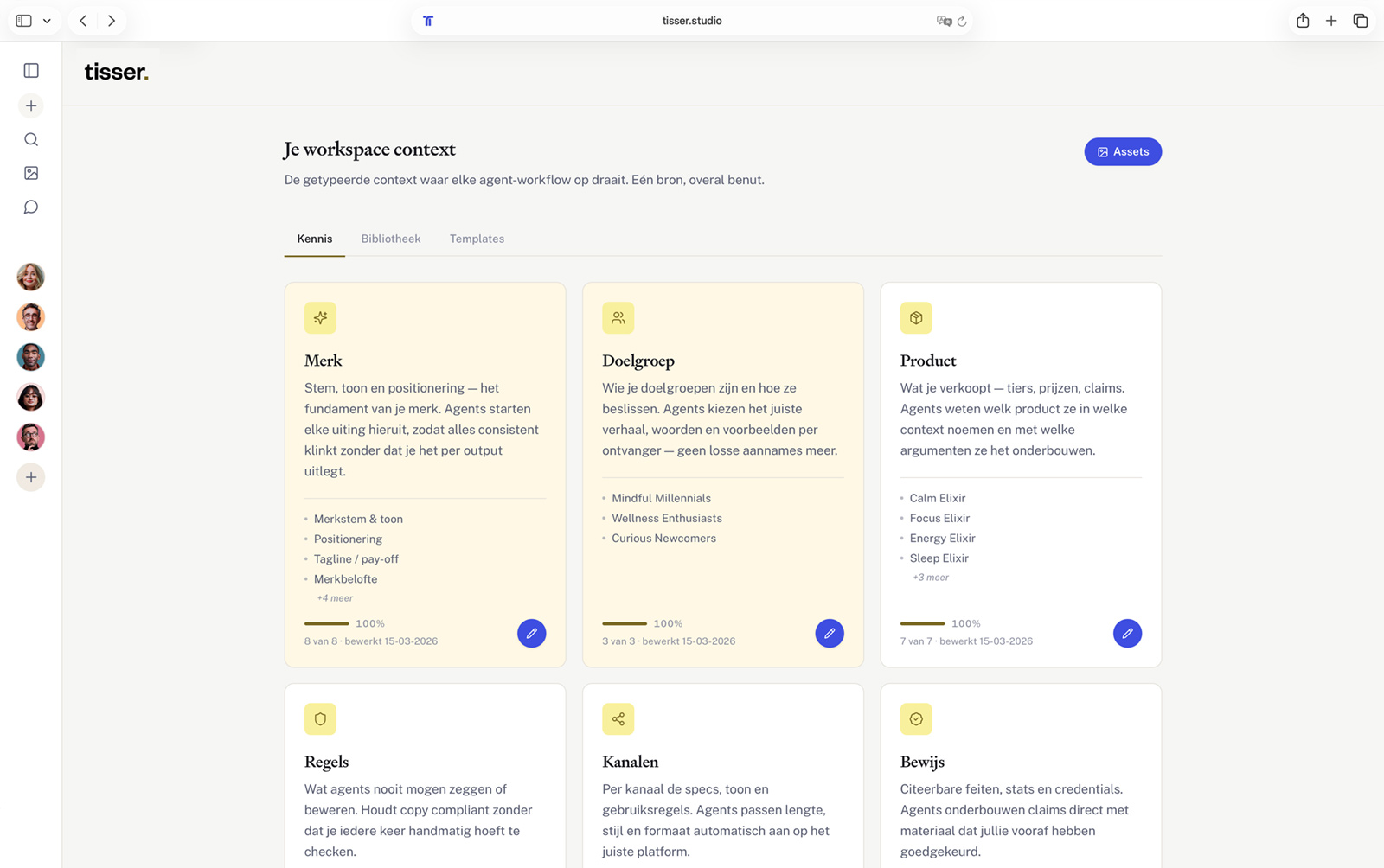
The workspace already knows your business: your tone, your catalog, your rules, the facts sitting in your own systems. That is what lets a team of agents do real work for you, instead of handing you drafts to fix.

One place, not eleven tabs.
The brief, the agents doing the work, the draft, the image and the approval all happen in the same window. The conversation runs on the left; the thing being made stands open on the right. You watch it happen and step in wherever you want to.


Ten specialists, one set of rules.
Not one generic assistant. A team where every role has its own job description and its own memory. The same brand contract binds all ten. You bring in the ones the work needs; Oscar decides which those are.

Oscar
CoordinatorReads the request, decides which agents it needs and coordinates the run.

Nora
StrategistTurns an objective into audience, positioning and measurable KPIs.

May
Brief builderStructures the chaos into one brief, one scope, one set of approvals.

Lynn
CopywriterPerformance-ready copy in your voice, checked against your claims.

Max
Creative directorTranslates strategy into a distinctive concept and steers it to approval.

Rick
DesignerScalable campaign visual systems and spec-correct assets, every channel.

Kai
Social media managerPlatform-native social content and the community work around it.

Vera
Market analystDetects market signals and turns them into evidence-backed intelligence.

Rafa
Analytics leadTurns raw signals into KPI frameworks and optimisation decisions.

Tom
Account directorOwns scope, alignment and the cadence of client communication.

Plugs into the systems you already work in.
Your CRM, your analytics, your drive, your calendar, the channels you publish to. Connect them once and every agent works from what is in them today, and the finished work goes back out through the same tools, so nothing gets copied across by hand.
For your legal team.
- Data residency
- All processing and storage in EU datacenters. Nothing leaves the EU. One contract, not forty personal accounts on personal cards.
- GDPR
- Standard DPA available before the first workshop. Data deleted on contract end, on a schedule you set.
- EU AI Act
- Article 50’s transparency obligations apply from 2 August 2026. Tisser One labels machine-drafted content by default. Because a named person reviews and holds editorial responsibility for every published piece, the human-review path through Article 50 is built into how the loop already runs.
- Access
- Named accounts per user. Approval rights assigned per person, per channel, so “who can publish what” is a setting, not a policy PDF.
- Audit
- Full activity trail, exportable, readable without Tisser present.
In production, not in pilot.


From this page to a working team.
Software alone doesn’t change how a team works. We run the kickoff, we stay through the first live work, and we are in the room while your team gets used to it. That’s included. An honest word: early on the drafts will need real editing. That’s not a flaw in the loop, it’s the loop. Your corrections are what make it good.
First week
Getting set up
We sit down with your team and fill the workspace with what it needs to know about your business.
Second week
Trying it on real work
Your people put actual jobs through it and see what comes back, with us alongside them.
Third week
Sharpening and widening
We tune the rules on what you corrected, and start opening up the next workflows and connections.
Before you book the call.
How do I keep AI content sounding like us?
You write down what that means once. Every draft is written against those rules, and a person on your team approves it before it goes out.
Who checks it before it’s published?
Someone on your team, by name. Anything going outside the company waits for them.
We already have brand guidelines. Do we start over?
No. Most brands start by writing down what already exists.
Which AI models does this use?
Whichever fits the task. Your rules sit above the model, so a model change never means a rules change.
Where does our data live?
In the EU, on ISO 27001-certified Google Cloud infrastructure. The certificate is Google’s, for the data centers; we don’t claim one of our own.
What does it cost?
It depends on the shape of your setup: how many people work in it, how many agents and workflows you run, how many brands, how many systems you connect. That is why there is no calculator here. You get your figure on the intro call, whether you buy or not.
How is this different from ChatGPT with a good prompt?
A prompt is a suggestion and it lives with one person. Rules are written down, apply to everyone, and the work stops for approval before it goes out.
Come and see it work.
Thirty minutes with a founder, not an SDR. The product live, and your technical and compliance questions answered on the spot. Pick a slot in the calendar; your data stays in the EU.