Anatomy of a brand context: the file that keeps agents on voice.
Every agent in Tisser works from one typed context: nine cards that together are the brand, written down once. This is what each card holds — and the specific failure it prevents.
The principle first. An agent without context does not produce nothing — it produces something, confidently, from averages. Every card below replaces one class of averages with one class of decisions.
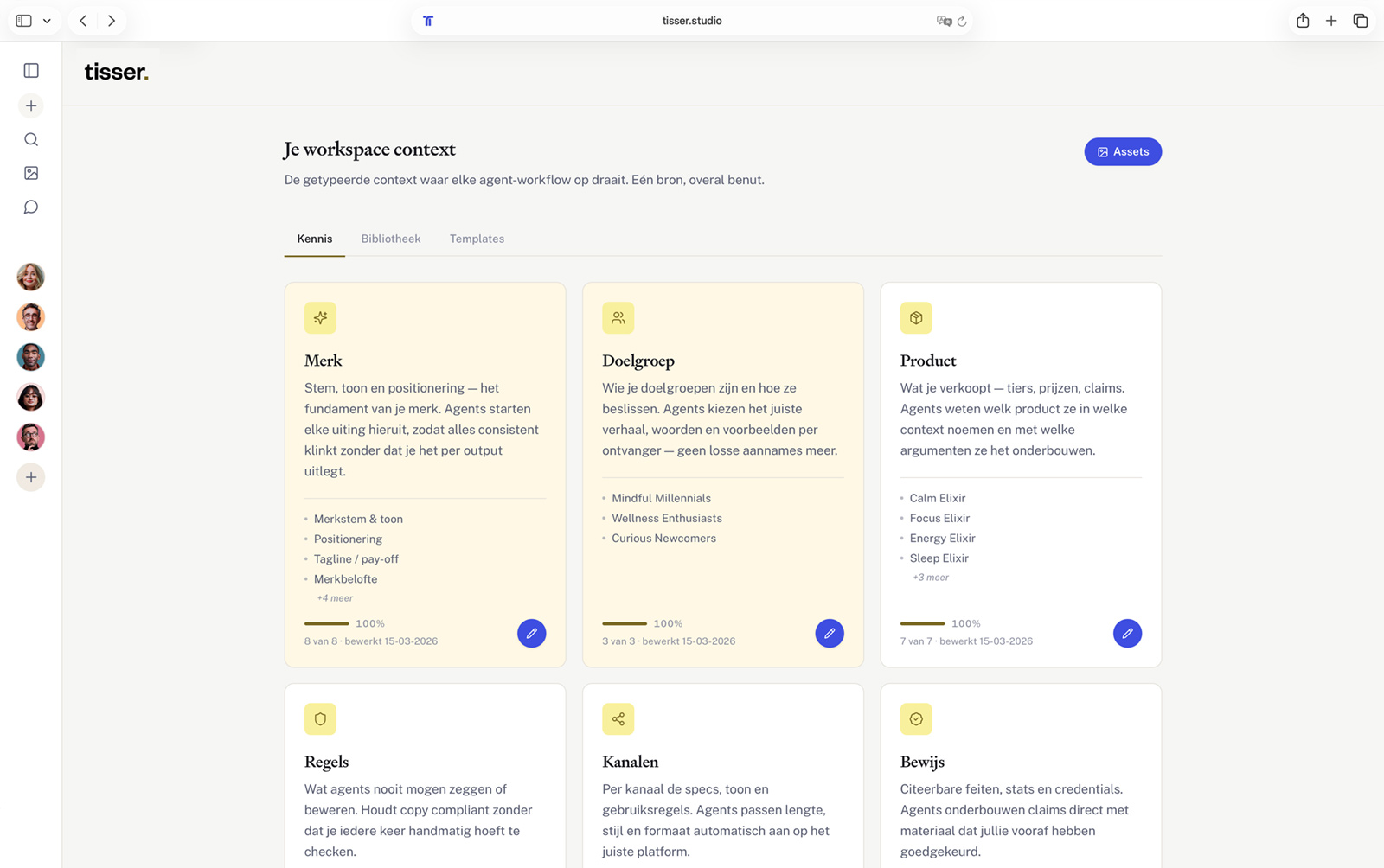
1 · Brand
Voice, tone and positioning — the foundation. Agents start every piece from this, so output sounds consistent without the writer pasting the tone-of-voice chapter into every prompt. Prevents: the generic register — work that reads like everyone else's AI.
2 · Audience
Who the groups are and how they decide. Agents choose the right story, words and examples per recipient — no loose assumptions. Prevents: one message stretched over five audiences.
3 · Product
What you sell — tiers, prices, claims. Agents know which product to name in which context and which arguments to build on. Prevents: invented features and yesterday's prices.
4 · Rules
What agents may never say or claim. Hard copy-compliance without a person checking by hand every time — refusals cite the rule and the page. Prevents: the blunder dossier.
5 · Channels
Per channel: the specs, tone and usage rules. Agents adjust length, style and format automatically. Prevents: the LinkedIn post that is obviously a shrunken blog.
6 · Proof
Citable facts, stats and credentials — material you approved in advance. Agents substantiate claims directly with it. Prevents: statistics from nowhere.
7 · Campaigns
What is running now and what ran before. New work lands inside the story you are already telling. Prevents: the reset-to-zero every brief used to start with.
8 · Competitors
Who they are and how you position against them — including what you refuse to say about them. Prevents: accidental comparative claims, the legally expensive kind.
9 · Sales play
How you sell: motions, objections, the language of the deal. Marketing and sales output stop contradicting each other. Prevents: the support reply that undoes the campaign promise.
Why cards, and not one big document
Because agents read like machines: a typed card can be attached to the jobs where it is relevant, versioned when it changes, and checked at the gate. One brand PDF cannot — it can only be pasted, truncated and hoped about. The difference between a brand document and a brand context is the difference between describing and deciding — the same line that separates a guideline from a contract.
See your own brand as nine cards.
Setting up the context is the first week of the two-week programme.