Stop rewriting AI drafts. Start approving them.
Product pages in bulk, newsletters, campaign content — drafted by a team of specialists working from your rules, your catalog and your channels. Nothing goes out until someone on your team signs it.

One place, not eleven tabs.
The brief, the agents doing the work, the draft, the image and the approval all happen in the same window. The conversation runs on the left; the thing being made stands open on the right. You watch it happen and step in wherever you want to.
Switch models, keep your work
Change the model mid-task and the thread, the context and the rules stay put. Pick a different engine halfway through a draft and nobody has to re-explain the brief — the work carries on from exactly where it was.
Visible reasoning
See which context, rule and agent shaped the answer. When a draft surprises you, you can tell at a glance whether the brief was off or the rule was, instead of guessing at a black box and rewriting on instinct.
Remembers what you tell it
Save a preference once and Tisser applies it everywhere from then on. The correction you make today stops coming back next week — it becomes a rule the next brief already knows about.
Edit with words
“Put her on a beach” and the whole scene follows — light, background and shadow move with it. No masks, no layers, no round trip for a change you can describe in one sentence.
Thinking
RuleBrand contract · 4.2
AudienceMindful Millennials
AgentLynn
ActionDraft post
New preference
no dashes in bullet points


Inside the workspace
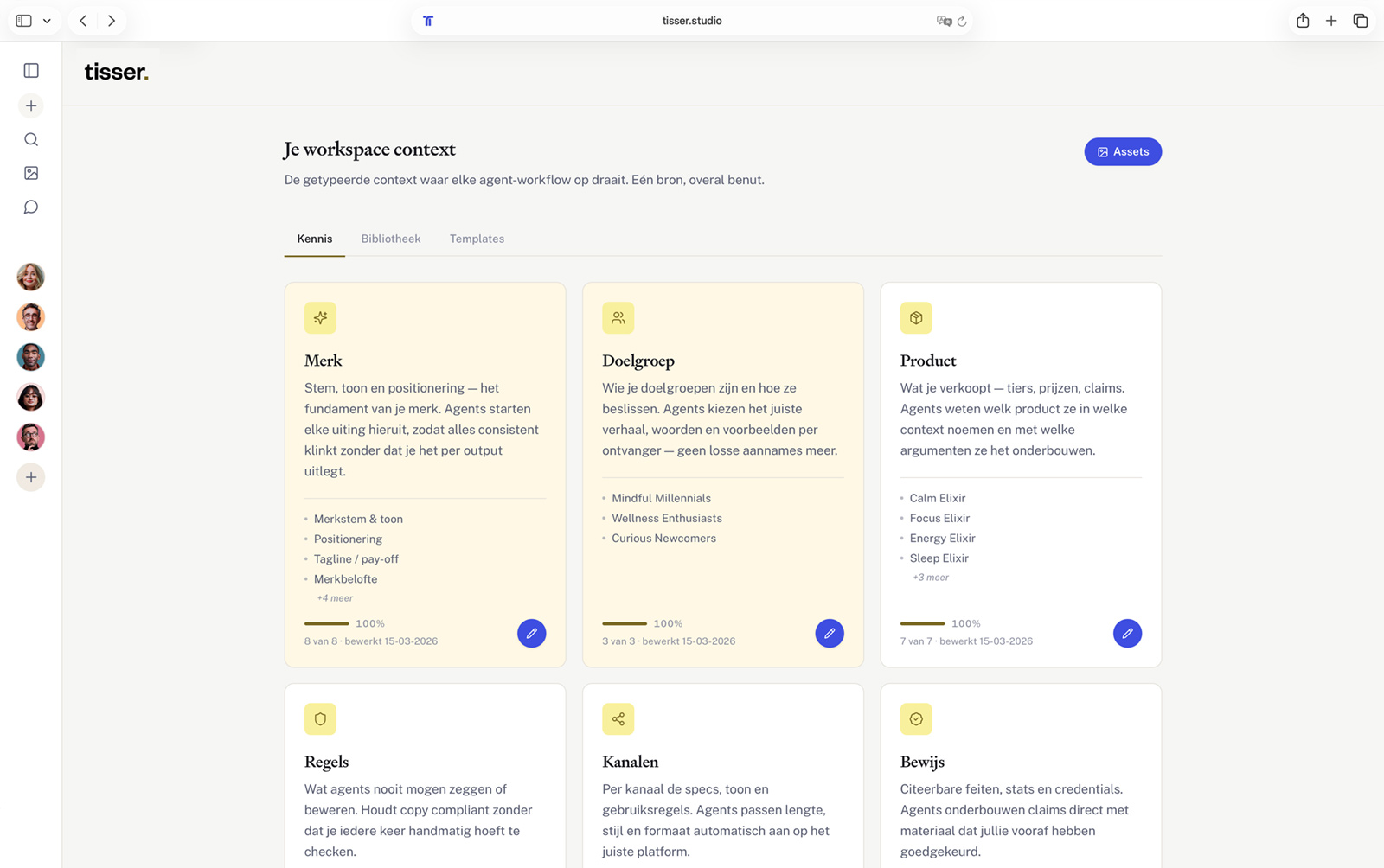
Everything the work needs, behind one door.
Four screens your team lives in. Same rules, same memory, same audit trail behind all of them.


Connect what matters to your business.
Your brand facts are not in one place. They sit in the CRM, the analytics, the drive, the calendar and the channels you publish to — and they change without anyone telling the AI.
Connect those sources to the workspace and every agent drafts from what is true today rather than from what someone pasted into a prompt last quarter. The finished work goes back out through the same tools your team already opens every morning, so nothing has to be copied across by hand and nothing lives in a chat window only one person can find.
What you get
Ten specialists, one set of rules.
Not one generic assistant. A team where every role has its own job description and its own memory — and the same brand contract binds all ten. You bring in the ones the work needs; Oscar decides which those are.

Oscar
CoordinatorReads the request, decides which agents it needs and coordinates the run.

Nora
StrategistTurns an objective into audience, positioning and measurable KPIs.

May
Brief builderStructures the chaos into one brief, one scope, one set of approvals.

Lynn
CopywriterPerformance-ready copy in your voice, checked against your claims.

Max
Creative directorTranslates strategy into a distinctive concept and steers it to approval.

Rick
DesignerScalable campaign visual systems and spec-correct assets, every channel.

Kai
Social media managerPlatform-native social content and the community work around it.

Vera
Market analystDetects market signals and turns them into evidence-backed intelligence.

Rafa
Analytics leadTurns raw signals into KPI frameworks and optimisation decisions.

Tom
Account directorOwns scope, alignment and the cadence of client communication.
For IT and compliance
Your legal team will read this page too.
- Data residency
- All processing and storage in EU datacenters. Nothing leaves the EU. One contract, not forty personal accounts on personal cards.
- GDPR
- Standard DPA available before the first workshop. Data deleted on contract end, on a schedule you set.
- EU AI Act
- Article 50’s transparency obligations apply from 2 August 2026. Tisser One labels machine-drafted content by default — and because a named person reviews and holds editorial responsibility for every published piece, the human-review path through Article 50 is built into how the loop already runs.
- Access
- Named accounts per user. Approval rights assigned per person, per channel — so “who can publish what” is a setting, not a policy PDF.
- Audit
- Full activity trail, exportable, readable without Tisser present.
◻ AI-drafted · reviewed by Mara de Vries · 24 Jul 2026 — the label Article 50 asks for. The full security page.
Who runs it
In production, not in pilot.
bol. · Equans · Tony’s Chocolonely · Basic-Fit
[ customer quote — one, two sentences, answering the problem, not the product ]
Getting live
Two weeks from this page to a working team.
Software alone doesn’t change how a team works. We run the kickoff, connect your sources with you, train your approvers, and stay through the first live campaigns. That’s included. An honest word: in week one the drafts will need real editing — that’s not a flaw in the loop, it’s the loop. Your corrections are what make month three good.
Day 1
Sources connected
Brand memory intake — tone, catalog, channel rules.
Week 1
First draft in your queue
Agents draft against real briefs; approvers review.
Week 2
Team live
Full team running, audit trail from day one.
Setting up the brand contract is a named programme with a fixed scope and an end date. See the programmes →
Questions your team will ask
Before you book the call.
How do I keep AI content sounding like us?
You write down what that means once. Every draft is written against those rules, and a person on your team approves it before it goes out.
Who checks it before it’s published?
Someone on your team, by name. Anything going outside the company waits for them.
We already have brand guidelines. Do we start over?
No. Most brands start by writing down what already exists.
Which AI models does this use?
Whichever fits the task. Your rules sit above the model, so a model change never means a rules change.
Where does our data live?
In the EU, on ISO 27001-certified Google Cloud infrastructure. The certificate is Google's, for the data centres; we don't claim one of our own.
What does it cost?
One price per brand, per month — no calculator. What shapes it is on the pricing page.
How is this different from ChatGPT with a good prompt?
A prompt is a suggestion and it lives with one person. Rules are written down, apply to everyone, and the work stops for approval before it goes out.
Bring your own work. We’ll run it through the rules.
30 minutes, with a founder — not an SDR. Pick a slot in the calendar. Your data stays in the EU.
Want the same rules without us in the room? That’s Tisser Studio — closed beta.